Bone Spavin in the Horse's Hock - definition and treatment
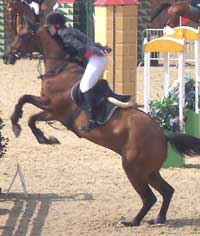
A horse's hocks are put under
a lot of strain
Definition: Bone spavin is the development of arthritic or degenerative changes - creating bony growth - within the three relatively immobile lower joints of a horse's hock.
It is a common cause of lameness in the hind leg of a horse - although usually worse in one hind leg, both are normally affected.
A Bone spavin has a gradual onset and can affect any type of horse or pony during its adult life.
Its incidence seems to bear little relation to the amount or type of work that a horse or pony does.
The three joints in the horse's hock that are affected are the articulation of the cannon bone with the hock joint and with the bones within the lower part of the hock joint itself.
The type of changes that can occur are cartilage degeneration, bone destruction and changes within the joint capsules around the bones of these equine joints.
The degree to which these changes occur varies dramatically from horse to horse. Some will have large destructive lesions that affect all three lower joints of the hock, whilst others have small spurs of bone that form along the joint edges.
The rate of progression of these changes can also vary.
Some horses will suffer rapid degeneration in their joints whilst in others the condition will remain static after the initial onset of arthritic changes are detected.
X-Rays usually reveal the type of bone spavin that a horse is suffering from, and an equine veterinary surgeon will be able to advise on the prognosis for a particular horse
TREATMENT OF BONE SPAVIN IN A HORSE OR PONY
Changes to the lower hock joint caused by bone spavins are mostly irreversible. But it is possible to manage the condition and slow the progression of the disease, give pain relief, and as a result control the lameness.
The common veterinary treatment involves allowing the horse to carry on working under the influence of equine anti-inflammatory pain killing drugs such as phenylbutazone (bute) - provided that the pain relief drugs are effective and the horse is not in pain or lame.
The horse's workload may have to be reduced for this method to succeed, and the horse or pony may not be able to continue in his chosen career - but most horses respond very well to this treatment of bone spavin and can certainly become sound enough to enjoy rides out across the countryside.
Another method of treatment involves the intra-articular injection of corticosteroids or hyaluronic acid into the affected joints.
Another options are usually surgical -involving fusion of the affected joints - this is known as surgical arthrodesis - which aims to stabilise and as a result remove inflammation and pain form the joints. This involves drilling out the joint surfaces to destroy the cartilage that covers them which stimulates the underlying bone to fuse together as one solid area of bone.
SHOEING TO HELP HORSES WITH BONE SPAVINS
A good farrier can greatly assist the management and care of a horse suffering with bone spavin.
Shoes that are most useful for horses with bone spavins include shoes that help breakover - with a rolled or square toe, or with wedge pads. Some farriers will use horseshoes with heel support - for example egg bar shoes.
ALTERNATIVE AND HERBAL REMEDIES FOR BONE SPAVIN IN HORSES
Many horse owners have had success with feeding joint supplements such as Glucosamine and natural pain relief supplements such as Devil's Claw
HORSE CARE ADVICE AND EQUESTRIAN ARTICLES
Treating Ringbone homeopathically | Devil's Claw | Cushings disease | Feed Balancers | Sarcoids | Horse worming | Contracted Tendons in Foals | Glucosamine for horses | Veteran horses | Magnotherapy | Gloucestershire Horse Feed | Equine nosebleeds | Cracked Heels | Selenium | Choke | Australian Cheeker Noseband | Angleberry warts | Redworm | Mud fever | Removing Bot Eggs | Devil's Claw | Horse bedding | Mare in Foal | Pelham Bit | Horse feed supplies - Norfolk | Horse Dentistry | Hoof care | Aubiose | Colic | Sweet Iron Bit | Liver | Calming Herbs | Sticky Stifle | Hay Steamers | Headshaking | Moody Mare Supplement | White Line Disease | B vitamins horses | Biotin | Haylage | Probiotics | Loose Stools | Arthritis Supplements for Horses | Salt |
Bone Spavin lameness in the Horse's Hock - causes, definition, remedies and treatment